Form.Decoder
Main module that exports primitive decoders and helper functions for form decoding.
Types
An alias for special decoder that does not produce any outputs. It is used for just validating inputs.
Decode functions
Basic function that decodes input by given decoder.
run (int "Invalid") "foo"
--> Err [ "Invalid" ]


run (int "Invalid") "34"
--> Ok 34Checks if there are errors.
errors (int "Invalid") "foo"
--> [ "Invalid" ]


errors (int "Invalid") "34"
--> []
Primitive decoders
Decoder into Int, raising err when a input is invalid for an integer.
run (int "Invalid") "foo"
--> Err [ "Invalid" ]


run (int "Invalid") "34"
--> Ok 34


run (int "Invalid") "34.3"
--> Err [ "Invalid" ]


run (int "Invalid") "34e3"
--> Err [ "Invalid" ]Decoder into Float, raising err when a input is invalid for an float.
run (float "Invalid") "foo"
--> Err [ "Invalid" ]


run (float "Invalid") "34"
--> Ok 34


run (float "Invalid") "34.3"
--> Ok 34.3


run (float "Invalid") "34e3"
--> Ok 34000Primitive decoder that always succeeds with constant value.
run (Form.Decoder.always "bar") "foo"
--> Ok "bar"


run (Form.Decoder.always 34) 23
--> Ok 34Primitive decoder that always succeeds with input as it is.
run Form.Decoder.identity "foo"
--> Ok "foo"


run Form.Decoder.identity 34
--> Ok 34Primitive decoder which always results to invalid.
run (fail "error") "foo"
--> Err [ "error" ]


run (fail "error") <| Just 34
--> Err [ "error" ]


run (when (\n -> n < 0) <| fail "error") -1
--> Err [ "error" ]


run (when (\n -> n < 0) <| fail "error") 0
--> Ok ()
Primitive validators
Primitive validator limiting by minimum bound.
run (minBound "Too small" 10) 2
--> Err [ "Too small" ]Primitive validator limiting by maximum bound.
run (maxBound "Too large" 100) 200
--> Err [ "Too large" ]Primitive validator limiting by minimum length.
run (minLength "Too short" 10) "short"
--> Err [ "Too short" ]Primitive validator limiting by maximum length.
run (maxLength "Too long" 10) "tooooooooo long"
--> Err [ "Too long" ]
Custom decoders
Constructor for Decoder input err a.
type Error
    = TooSmall
    | InvalidInt


customValidator : Validator Int Error
customValidator =
    custom <| \n ->
        if n < 10
            then Err [ TooSmall ]
            else Ok ()


customInt : Decoder String Error Int
customInt =
    custom <| Result.fromMaybe [ InvalidInt ] << String.toInt


run customValidator 8
--> Err [ TooSmall ]


run customInt "foo"
--> Err [ InvalidInt ]
Helper functions for validation
Apply validator on given decoder. If a input is invalid for given validator, decoding fails.
type Error
    = Invalid
    | TooSmall
    | TooBig


validator1 : Validator Int Error
validator1 =
    minBound TooSmall 3


validator2 : Validator Int Error
validator2 =
    maxBound TooBig 6


myDecoder : Decoder String Error Int
myDecoder =
    int Invalid
        |> assert validator1
        |> assert validator2


run myDecoder "foo"
--> Err [ Invalid ]


run myDecoder "32"
--> Err [ TooBig ]


run myDecoder "2"
--> Err [ TooSmall ]


run myDecoder "3"
--> Ok 3Only checks validity if a condition is True.
type alias Form =
    { enableCheck : Bool
    , input : String
    }


type Error
    = TooShort


myValidator : Validator Form Error
myValidator =
    when .enableCheck <|
        lift .input <|
            minLength TooShort 3


run myValidator { enableCheck = True, input = "f" }
--> Err [ TooShort ]


run myValidator { enableCheck = False, input = "f" }
--> Ok ()


run myValidator { enableCheck = True, input = "foo" }
--> Ok ()Only checks validity unless a condition is True.
type alias Form =
    { skipCheck : Bool
    , input : String
    }


type Error
    = TooShort


myValidator : Validator Form Error
myValidator =
    unless .skipCheck <|
        lift .input <|
            minLength TooShort 3


run myValidator { skipCheck = False, input = "f" }
--> Err [ TooShort ]


run myValidator { skipCheck = True, input = "f" }
--> Ok ()


run myValidator { skipCheck = False, input = "foo" }
--> Ok ()
Function to build up decoder for forms
lift is mainly used for accessing sub model of target value.
type alias Form =
    { field1 : String
    , field2 : String
    }


type Error
    = TooShort


run (lift .field1 <| minLength TooShort 5)
    (Form "foo" "barrrrrrrrrrr")
--> Err [ TooShort ]type alias Form =
{ str : String
, int : String
}
type alias Decoded =
{ str : String
, int : Int
}
type Error
= TooShort
| InvalidInt
strDecoder : Decoder String Error String
strDecoder =
Form.Decoder.identity
|> assert (minLength TooShort 5)
intDecoder : Decoder String Error Int
intDecoder =
int InvalidInt
formDecoder : Decoder Form Error Decoded
formDecoder =
map2 Decoded
(lift .str strDecoder)
(lift .int intDecoder)
run formDecoder (Form "foo" "bar")
--> Err [ TooShort, InvalidInt ]
run formDecoder (Form "foo" "23")
--> Err [ TooShort ]
run formDecoder (Form "foobar" "bar")
--> Err [ InvalidInt ]
run formDecoder (Form "foobar" "23")
--> Ok (Decoded "foobar" 23)Build up decoder for form.
It can be used as mapN.
mapN f d1 d2 d3 ... dN =
    top f
        |> field d1
        |> field d2
        |> field d3
        ...
|> field dNtype alias Form =
{ str : String
, int : String
}
type alias Decoded =
{ str : String
, int : Int
}
type FormError
= FormErrorStr StrError
| FormErrorInt IntError
type StrError
= TooShort
type IntError
= Invalid
strDecoder : Decoder String StrError String
strDecoder =
Form.Decoder.identity
|> assert (minLength TooShort 5)
intDecoder : Decoder String IntError Int
intDecoder =
int Invalid
formDecoder : Decoder Form FormError Decoded
formDecoder =
map2 Decoded
(mapError FormErrorStr <| lift .str strDecoder)
(mapError FormErrorInt <| lift .int intDecoder)
run formDecoder (Form "foo" "bar")
--> Err [ FormErrorStr TooShort, FormErrorInt Invalid ]
run formDecoder (Form "foo" "23")
--> Err [ FormErrorStr TooShort ]
run formDecoder (Form "foobar" "bar")
--> Err [ FormErrorInt Invalid ]
run formDecoder (Form "foobar" "23")
--> Ok (Decoded "foobar" 23)Advanced
Chain together a sequence of decoders.
type Error
    = InvalidInt
    | TooLong
    | TooBig


advancedDecoder : Decoder String Error Int
advancedDecoder =
    Form.Decoder.identity
        |> assert (maxLength TooLong 5)
        |> andThen (\_ -> int InvalidInt)
        |> assert (maxBound TooBig 300)


run advancedDecoder "foooooo"
--> Err [ TooLong ]


run advancedDecoder "foo"
--> Err [ InvalidInt ]


run advancedDecoder "1000000"
--> Err [ TooLong ]


run advancedDecoder "500"
--> Err [ TooBig ]


run advancedDecoder "200"
--> Ok 200Advanced function to build up case-sensitive decoder.
type alias Form =
    { selection : Maybe Selection
    , int : String
    , str : String
    }


type Selection
    = IntField
    | StrField


type Selected
    = SelectInt Int
    | SelectStr String


type Error
    = TooShort
    | InvalidInt
    | NoSelection


myDecoder : Decoder Form Error Selected
myDecoder =
    with <| \form ->
        case form.selection of
            Just IntField ->
                map SelectInt <|
                    lift .int intDecoder
            Just StrField ->
                map SelectStr <|
                    lift .str strDecoder
            Nothing ->
                fail NoSelection


intDecoder : Decoder String Error Int
intDecoder =
    int InvalidInt


strDecoder : Decoder String Error String
strDecoder =
    Form.Decoder.identity
        |> assert (minLength TooShort 5)


run myDecoder <| Form (Just IntField) "foo" "bar"
--> Err [ InvalidInt ]


run myDecoder <| Form (Just StrField) "foo" "bar"
--> Err [ TooShort ]


run myDecoder <| Form (Just IntField) "23" "bar"
--> Ok <| SelectInt 23


run myDecoder <| Form (Just StrField) "23" "bar"
--> Err [ TooShort ]


run myDecoder <| Form (Just IntField) "foo" "barrrrr"
--> Err [ InvalidInt ]


run myDecoder <| Form (Just StrField) "foo" "barrrrr"
--> Ok <| SelectStr "barrrrr"


run myDecoder <| Form Nothing "foo" "barrrrr"
--> Err [ NoSelection ]
Helper functions for special situation
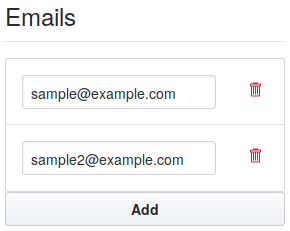
Supposed to be used for advanced input fields that user can append new input.
For example, some forms would accept arbitrary number of email addresses by providing "Add" button to prepend new input field.
type Error
    = TooShort
    | TooLong


decoder : Decoder String Error String
decoder =
    Form.Decoder.identity
        |> assert (minLength TooShort 1)
        |> assert (maxLength TooLong 5)


run (list decoder) [ "foo", "bar", "baz" ]
--> Ok [ "foo", "bar", "baz" ]


run (list decoder) [ "foo", "", "baz" ]
--> Err [ TooShort ]


run (list decoder) [ "foo", "", "bazbaz", "barbar" ]
--> Err [ TooShort, TooLong, TooLong ]import Array
type Error
= TooShort
| TooLong
decoder : Decoder String Error String
decoder =
Form.Decoder.identity
|> assert (minLength TooShort 1)
|> assert (maxLength TooLong 5)
run (array decoder) <| Array.fromList [ "foo", "bar", "baz" ]
--> Ok <| Array.fromList [ "foo", "bar", "baz" ]
run (array decoder) <| Array.fromList [ "foo", "", "baz" ]
--> Err [ TooShort ]
run (array decoder) <| Array.fromList [ "foo", "", "bazbaz", "barbar" ]
--> Err [ TooShort, TooLong, TooLong ]
Core type representing a decoder. It decodes input into type
a, raising error of typeerr.