elm-reference

An immutable approach imitating references of mutable languages.

Any PRs are welcome, even for documentation fixes. (The main author of this library is not an English native.)
Top of Contents
- What problem can
Referenceresolve? - Reference of mutable programing languages help us!
- Concept of the
Reference - Example code using
Reference - More examples
- Related works
What problem can Reference resolve?
It is often case to render list of sub views, such as TODO lists, registered user lists, list of posts, etc...
Reference is useful in such cases.
Here is an part of simple application code that increments numbers on each row by clicking.
init : ( Model, Cmd Msg )
init =
    ( { nums = [ 1, 2, 3, 4, 5, 6 ]
      }
    , Cmd.none
    )


-- MODEL


type alias Model =
    { nums : List Int
    }


-- UPDATE


type Msg
    = ClickNumber Int


update : Msg -> Model -> ( Model, Cmd Msg )
update msg model =
    case msg of
        ClickNumber idx ->
            ( { model
                | nums =
                    List.Extra.updateAt idx ((+) 1) model.nums
              }
            , Cmd.none
            )


-- VIEW


view : Model -> Html Msg
view model =
    div [] <| List.indexedMap renderRow model.nums


renderRow : Int -> Int -> Html Msg
renderRow idx n =
    div
        [ Events.onClick (ClickNumber idx)
        ]
        [ text <| toString n
        ]
In this code, index number of clicked number is passed to update function with ClickNumber message.
It is common technique of the Elm architecture, but it does not seem to be straightforward...
How can we realize this sort of probrem intuitively?
Reference of mutable programing languages help us!
Some mutable programing languages can handle reference as following example of JS.
> arr = [ {val: 1}, {val: 2}, {val: 3} ]
> x = arr[1]
> x.val = 3
> arr
[ { val: 1 }, { val: 3 }, { val: 3 } ]
If Elm could handle references as mutable languages, it would be possible to resolve the previous problem by passing reference of the clicked number to the Msg instead of index as follows.
type Msg
    = ClickNumber SomeSortOfReference
The basic motivation of Reference library is to empower the references of mutable languages to the Elm.
Concept of the Reference
Reference has concept of this and root.
thismeans focused value (x = arr[1]in the previous JS example)rootmeans root value (arrin the previous JS example)
The core data type of Reference is Reference this root, which can be created by providing this value and function to specify how root depends on the this value.
fromRecord : { this : a, rootWith : a -> root } -> Reference a rootTo pick out this value and root value from Reference, use following functions.
this : Reference this root -> this
root : Reference this root -> root
Now we can create Reference and then pick out this and value.
ref : Reference Int (List Int)
ref = fromRecord
    { this = 3
    , rootWith = \x -> [1,2] ++ x :: [4,5]
    }

this ref
--> 3

root ref
--> [ 1, 2, 3, 4, 5 ]
Next, let's modify the ref value declared in the above example.
We can use modify for the purpose.
modify : (a -> a) -> Reference a root -> Reference a rootAs you can see in the bellow example, modify also updates root value.
ref2 : Reference Int (List Int)
ref2 = modify (\n -> n + 1) ref

this ref
--> 3
this ref2
--> 4

root ref
--> [ 1, 2, 3, 4, 5 ]
root ref2
--> [ 1, 2, 4, 4, 5 ]
Example code using Reference
The following code is the same application using References instead of index numbers.
type Msg
    = ClickNumber (Reference Int (List Int))


update : Msg -> Model -> ( Model, Cmd Msg )
update msg model =
    case msg of
        ClickNumber ref ->
            ( { model
                | nums =
                    Reference.root <| Reference.modify ((+) 1) ref
              }
            , Cmd.none
            )


view : Model -> Html Msg
view model =
    div [] <| Reference.List.unwrap renderRow <| Reference.top model.nums


renderRow : Reference Int (List Int) -> Html Msg
renderRow ref =
    div
        [ Events.onClick (ClickNumber ref)
        ]
        [ text <| toString <| Reference.this ref
        ]
More examples
Though it would not seem to be better than index number version of code in previous example, it can be more powerful when we have to handle nested list like tree.
type alias Model =
    { tree : List Node
    }


type Node
    = Node Int (List Node)
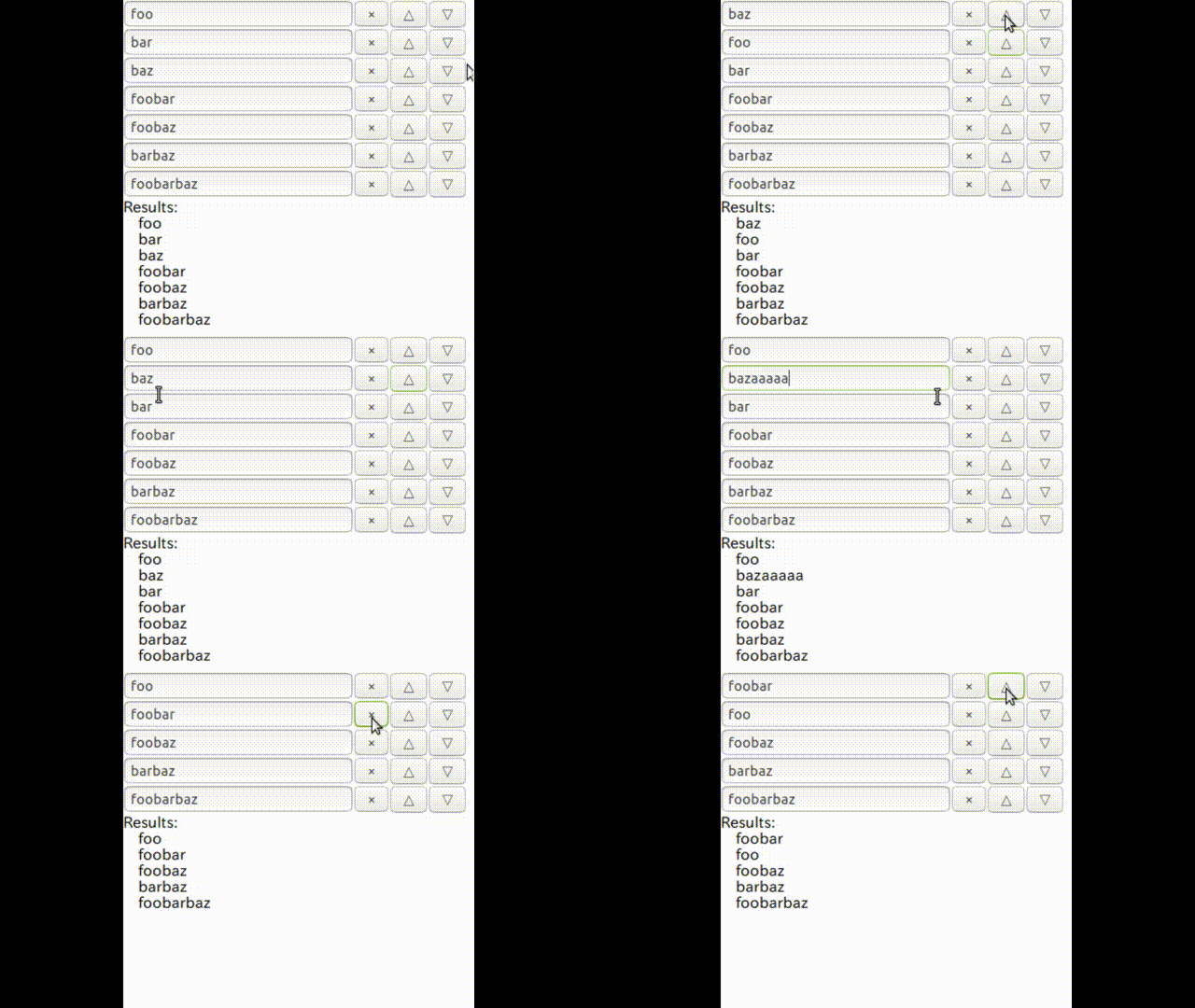
Example codes including such cases are available in the example directory.
Related works
Lens
Monocle-Lens is one of the similar concept to Reference.
There are three reasons why I developed this library.
First, this is not completely the same structure with Lens. Reference this root can be rewritten by following definition.
type alias Reference this root = ( this, Lens this root )The main target usage of this library is updating list value when some events are fired on sub view as example app described previously.
So, it is important to hold current value (i.e., this) itself in the data type.
Second, it is recommended to target a concrete use case as Designing APIs of elm-package says.
It means elm-reference should be published as an independent library to handle concrete use case described above.
Third, the Reference.List.unwrap function is so powerful for such a usage but not so easy for end users to implement by themselves.
It is worth publishing elm-reference just to provide Reference.List.unwrap.
Zipper
There is an approach called Zipper to handle tree-like structures.
For example, following implementations exist.
zwilias/elm-rosetree/Tree-Zippersimple but fasttomjkidd/elm-multiway-tree-zippersturdy but fasterturboMaCk/lazy-tree-with-zipper- [Experimental] lazy but very fast
The relation between Zipper and Reference is:
thisis equivalent to alabelrootis equivalent to thezipped treerefis equivalent to a tree zipper
But Zipper is not exactly for the purpose of updating an element by View events.
I guess it's not so easy question "How to resolve Vue tree view example in Elm using Zipper?".
In that point of view, Reference is more suitable to handle such problems.
(Of course, it is recommended to use Zipper if an application requires tree navigation feature.)
From another point of view, Reference is one of the abstraction of tree Zipper.
The Zipper is specialized version of Reference (type alias Zipper a = Reference a (Tree a)).
It means Reference can handle any structures in addition to Tree.
One example that Zipper cannot handle is strange Tree structure such as type BiTree = Node (List BiTree) (List BiTree).
Another example that Zipper could not handle easily is UpDown example in the example directory.