elm-3d-camera
This package provides convenient ways to define and use perspective and
orthographic cameras in 3D. It is based on elm-geometry
and has two main goals:
- Provide a way to construct WebGL
model/view/projection matrices that is more intuitive than using
elm-explorations/linear-algebradirectly - Provide standalone 3D-to-2D projection functionality that can be used outside of WebGL
Defining cameras
To define a camera, you first create a viewpoint which represents the position and orientation of the camera:
import Viewpoint3d
import Point3d
import Direction3d

cameraViewpoint =
    Viewpoint3d.lookAt
        { eyePoint = Point3d.meters 10 0 5
        , focalPoint = Point3d.origin
        , upDirection = Direction3d.positiveZ
        }
You can then create either a perspective or orthographic camera from the viewpoint:
import Camera3d
import Angle
import Length

perspectiveCamera =
    Camera3d.perspective
        { viewpoint = cameraViewpoint
        , verticalFieldOfView = Angle.degrees 30
        }

orthographicCamera =
    Camera3d.orthographic
        { viewpoint = cameraViewpoint
        , viewportHeight = Length.meters 5
        }
WebGL rendering
Once you have a camera, you can use it to get WebGL view and projection matrices:
import WebGL.Matrices as WebGL

viewMatrix =
    WebGL.viewMatrix camera

projectionMatrix =
    WebGL.projectionMatrix camera
        { nearClipDepth = Length.meters 0.1
        , farClipDepth = Length.meters 100
        , aspectRatio = 16 / 9
        }
Projection to screen space
You can also use a Camera3d to project points, lines, triangles and polylines
from 3D to 2D:
import Point3d.Projection as Point3d
import LineSegment3d.Projection as LineSegment3d

screen =
    Rectangle2d.from Point2d.origin
        (Point2d.pixels 800 600)

point2d =
    point3d |> Point3d.toScreenSpace camera screen

lineSegment2d =
    lineSegment3d
        |> LineSegment3d.toScreenSpace camera screen
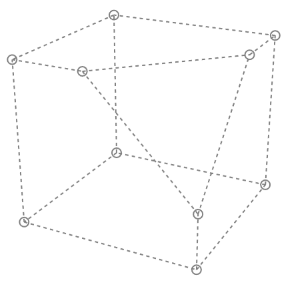
This allows you to, for example, do a perspective projection of 3D points and lines into 2D so that those points and lines can be rendered with SVG (taking advantage of SVG features like perfect circles and dashed lines which are difficult to do with WebGL):
Roadmap
A few more features are planned:
- More 3D-to-2D projections (directions, axes)
- Construction of 3D cut planes from 2D on-screen lines
Questions? Comments?
Please open a new issue if you
run into a bug, if any documentation is missing/incorrect/confusing, or if
there's a new feature that you would find useful. For general questions about
using elm-3d-camera, try:
- Joining the #geometry or #webgl channels on the Elm Slack, or sending me (@ianmackenzie) a message - even if you don't have any particular questions right now, it would be great to know what you're hoping to do with the package!
- Posting to the Elm Discourse forums
You can also find me on Twitter (@ianemackenzie),
where I occasionally post elm-geometry-related stuff like demos or new
releases. Have fun, and don't be afraid to ask for help!