Elm-regl
Elm bindings for regl.
Aims to provide a set of declarative APIs to use WebGL in Elm through regl. Users don't need to worry about the low-level implementation but can write flexible, powerful effects using shaders efficiently.
Usage
You can learn how to use Elm-regl in the following ways:
- See the examples in test.
- Read the API docs.
Example Usage
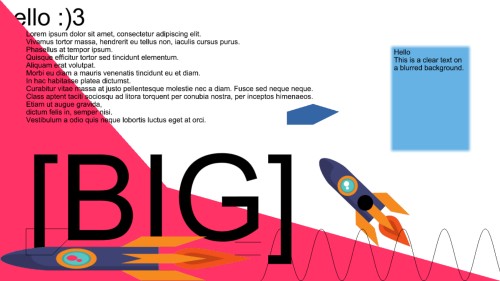
REGL.group [ REGL.crt 50 ]
    [ REGL.clear (Color.rgba 1 1 1 1)
    , REGL.textbox ( 0, 1050 ) 100 ("hello :)" "arial"
    , REGL.quad ( 0, 0 ) ( 1920, 0 ) ( 1920 / 3, 1080 / 3 ) ( 0, 1080 ) (Color.rgba 1 0.2 0.4 1)
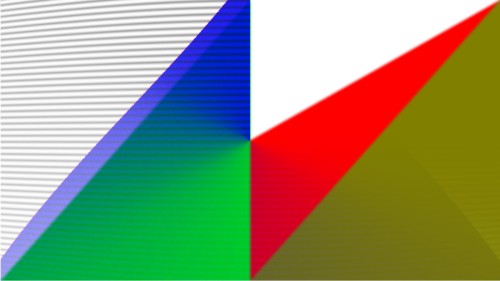
    , REGL.group [ REGL.blur 1 ]
        [ REGL.clear (Color.rgba 1 0.2 0.4 0)
        , REGL.triangle ( 700, 100 ) ( 700 + 100, 100 ) ( 700 + 100, 100 / 2 ) Color.red
        , REGL.triangle ( 500, 100 ) ( 500 + 100, 100 ) ( 500 + 100, 100 / 2 ) Color.green
        ]
    , REGL.poly
        [ ( 1100, 600 )
        , ( 1100, 650 )
        , ( 1200, 680 )
        , ( 1300, 650 )
        , ( 1200, 600 )
        ]
        Color.blue
    , REGL.texture ( 0, 0 ) ( 600, 0 ) ( 600, 300 ) ( 0, 300 ) "enemy"
REGL.group is similar to group in Elm-Canvas.
It groups a list of Renderables into one. Renderable is a drawing command. Elm-regl provides several basic drawing commands like triangles, circles, etc.
Unlike Elm Canvas, Elm-regl provides higher flexibility for one to operate on Renderables.
First, every Effect (similar to Setting in Elm-Canvas) is a shader that could be parameterized or customized by the users.
Second, users could use Compositors, e.g.,
REGL.Compositors.imgFade "mask" t renderable1 renderable2to composite two groups of Renderables. Users also could write custom compositors through the GLSL shader language.
Notable Features
- Use Framebuffer Objects (FBO) to draw.
- Use Multi-channel Signed Distance Field (MSDF) to render text.
- Efficient port in JS.
The corresponding JS port is open-sourced at elm-regl-js.