Elm OAuth 2 
This package offers some utilities to implement a client-side OAuth 2 authorization in Elm. It covers all 4 grant types:
Implicit (Recommended): The most commonly used. The token is obtained directly as a result of a user redirection to an OAuth provider. The implicit grant type is used to obtain access tokens (it does not support the issuance of refresh tokens) and is optimized FOR PUBLIC CLIENTS.
Authorization Code: The token is obtained as a result of an authentication, from a code obtained as a result of a user redirection to an OAuth provider. The authorization code grant type is used to obtain both access tokens and refresh tokens and is optimized FOR CONFIDENTIAL CLIENTS such as the device operating system or a highly privileged application.
Resource Owner Password Credentials: The token is obtained directly by exchanging the user credentials with an OAuth provider. The resource owner password credentials grant type is suitable in cases WHERE THE RESOURCE OWNER HAS A TRUST RELATIONSHIP WITH THE CLIENT.
Client Credentials: The token is obtained directly by exchanging application credentials with an OAuth provider. The client credentials grant type MUST ONLY BE USED BY CONFIDENTIAL CLIENTS.
Getting Started
Installation
elm install truqu/elm-oauth2Usage (Implicit Flow)
0/ A few imports assumed
import OAuth
import OAuth.Implicit
import Url exposing (Url)
import Browser.Navigation as Navigation exposing (Key)
1/ A model ready to receive a token and a message to convey the sign-in request
type alias Model =
    { redirectUri : Url
    , error : Maybe String
    , token : Maybe OAuth.Token
    , state : String
    }

type Msg = SignInRequested { clientId : String, authorizationEndpoint : String }
2/ Init parses the token from the URL if any, and defines a model
init : { randomBytes : String } -> Url -> Key -> ( Model, Cmd Msg )
init { randomBytes } origin _ =
    let
        model =
            { redirectUri = { origin | query = Nothing, fragment = Nothing }
            , error = Nothing
            , token = Nothing
            , state = randomBytes
            }
    in
    case OAuth.Implicit.parseToken origin of
        OAuth.Implicit.Empty ->
            ( model, Cmd.none )

        OAuth.Implicit.Success { token, state } ->
            if state /= Just model.state then
                ( { model | error = Just "'state' mismatch, request likely forged by an adversary!" }
                , Cmd.none
                )

            else
                ( { model | token = Just token }
                , getUserInfo config token
                )

        OAuth.Implicit.Error error ->
            ( { model | error = Just <| errorResponseToString error }
            , Cmd.none
            )
3/ One replies to a sign-in request by redirecting the user to the authorization endpoint
update : Msg -> Model -> ( Model, Cmd Msg )
update msg model =
    case msg of
        SignInRequested { clientId, authorizationEndpoint } ->
            let
                auth =
                    { clientId = clientId
                    , redirectUri = model.redirectUri
                    , scope = []
                    , state = Just model.state
                    , url = authorizationEndpoint
                    }
            in
            ( model
            , auth |> OAuth.Implicit.makeAuthorizationUrl |> Url.toString |> Navigation.load
            )
Demo
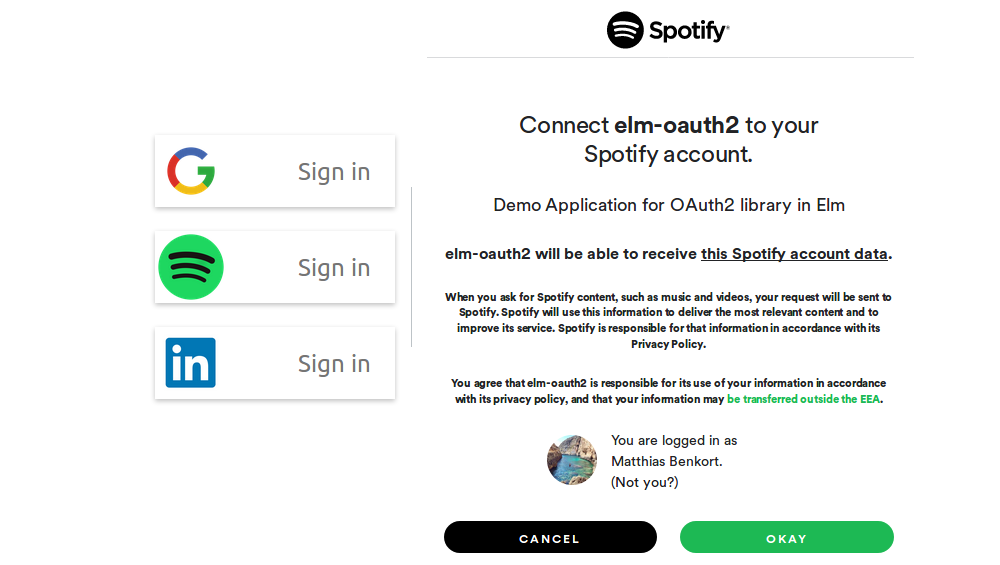
Complete examples are available here. Resulting applications can be seen on the following links:
Guides

